
Beyond Data Entry: How AI Agents Are Redefining Bank Reconciliation Workflows
Quick Answer
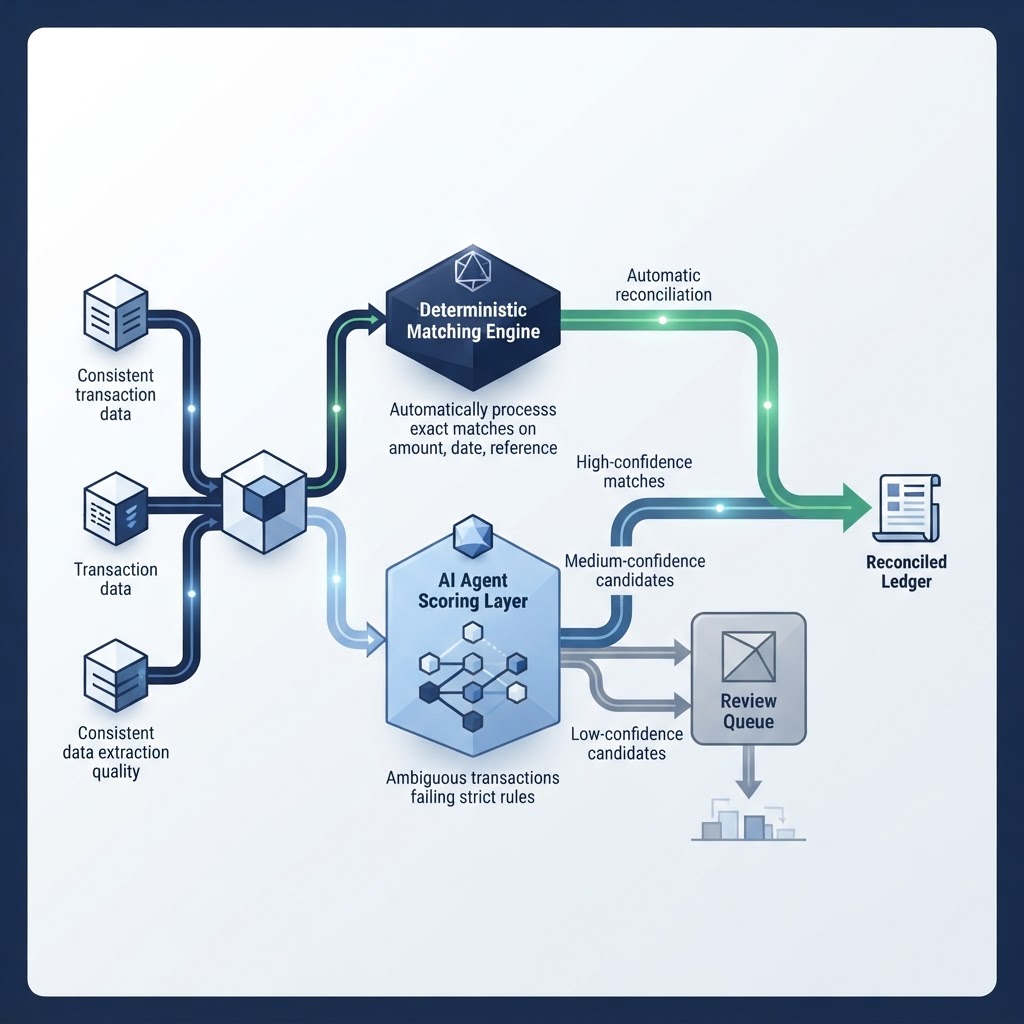
AI agents support bank reconciliation by scoring ambiguous transactions that fail strict rule-based matching, assigning a confidence level instead of a simple pass/fail result. This sits alongside deterministic matching rules, which handle exact matches on amount, date, and reference automatically. Together they shrink the exception queue so human reviewers only see transactions that genuinely need judgment — timing mismatches, split payments, or low-confidence candidates. The accuracy of both layers depends on consistent, structured transaction data going in, which is why extraction quality matters as much as the matching logic itself.
The Shift: From Manual Review to Exception-First Workflows
Picture the last day of the month. A bookkeeper opens the business bank statement, pulls up the general ledger, and starts matching lines one by one — a deposit here, a wire transfer there, a dozen card transactions that need to be traced back to receipts. By the time every line has been checked, hours have passed, and most of that time was spent confirming transactions that were never actually going to be a problem.
That's the core inefficiency in traditional reconciliation: attention gets spent uniformly across every transaction, when the real risk sits in a small subset — the ones that don't match cleanly. An exception-first workflow inverts this. Instead of reviewing everything and hoping to spot the few genuine problems, the system clears high-confidence matches on its own and routes only the unresolved items to a person. The reviewer's job shifts from "check every line" to "resolve every flagged exception."
This distinction matters because the two tasks require different skills. Clearing a transaction where the amount, date, and reference number all match exactly is mechanical — a rule can do it. Deciding whether a payment received three days late, with a slightly different description, is the same invoice or a different one requires judgment. Exception-first design puts machines on the mechanical work and people on the judgment calls.
The Three-Layer Architecture: Deterministic Rules, AI Matching, and Exception Routing
Reconciliation systems increasingly separate the matching problem into three distinct layers, each with a different job.
Layer 1: Deterministic Matching
Deterministic matching rules use fixed criteria — exact amount, exact date, and a shared reference number — to clear the bulk of transactions automatically. Because the logic is binary, every criterion either matches or it doesn't, these rules are fast, predictable, and easy to audit. According to ChatFin, deterministic rules handle most routine volume, leaving a smaller, messier remainder for more flexible methods.
Layer 2: Probabilistic (AI) Matching
Probabilistic matching handles that remainder: transactions that are almost certainly a match but fail one or more deterministic criteria. A payment posted a day late, a description abbreviated by the bank, or an amount off by a rounding difference all fall into this category. AI matching engines evaluate these candidates and assign a confidence score, which lets a system treat a 98% confidence suggestion differently than a 60% one, per Rework. Some platforms also use machine learning models trained on the patterns in a team's own historical manual reconciliations, so suggestions improve as the model sees more of how a specific business actually resolves its matches, as described by Workday.
Layer 3: Exception Routing
Anything that clears neither the deterministic rules nor the AI confidence bar becomes an exception. Rather than dumping all of these into one undifferentiated queue, effective systems classify them by the reason they failed. Oracle describes a classification scheme where exceptions are tagged as Ambiguous, Date-related, or Amount-related, which helps whoever picks up the exception understand what kind of discrepancy they're looking at before opening the transaction detail.
Designing the Matching Engine: Sequencing from Strict to Loose
The matching engine works best as a funnel that gets progressively looser:
- Exact match — amount, date, and reference number all align.
- Near match — amount and reference match, but the date falls within a defined tolerance window (for example, a transaction posted one to three business days apart).
- Fuzzy match — amount matches exactly or within a small tolerance, and the description is similar enough to suggest the same counterparty, but date and reference don't align.
- One-to-many matching — a single bank line, such as a batched merchant deposit, corresponds to multiple ledger entries, or multiple bank lines correspond to one ledger entry, such as a split payment. One-to-many matching requires the engine to sum candidate groups and compare the total against the target, rather than comparing single transactions pairwise.
Illustrative example (hypothetical, for illustration only): Imagine a bookkeeping team processes 600 transactions in a month. Running Tier 1 first clears every transaction where amount, date, and reference match exactly — say 400 lines. Tier 2 picks up another set where only the date is slightly off, maybe 120 lines. Tier 3's fuzzy matching, using AI confidence scoring, clears a further 60 lines. That leaves roughly 20 transactions in the exception queue. These figures are illustrative, not a benchmark — the point is that sequencing from strict to loose criteria filters the queue down at each stage, instead of running every rule against every transaction at once.
Governing AI Agents: Confidence Thresholds and Materiality Gates
How Do AI Agents Differ from Deterministic Matching Rules?
AI agents evaluate ambiguous transactions and produce a ranked suggestion with an associated confidence score, rather than a strict pass/fail outcome. Deterministic rules either match or they don't; there's no partial credit. AI matching, by contrast, can indicate that a candidate is an 87% likely match and let downstream policy decide what happens next, as outlined by Rework. That score is also informed by patterns learned from how a team has resolved similar transactions previously, per Workday — something a fixed rule set cannot do on its own.
Setting the Thresholds
A confidence threshold is the minimum score a candidate match needs to clear automatically without human review. A materiality limit is a dollar-value ceiling: even a high-confidence match might still require review if the amount involved exceeds a set threshold, because the cost of an error scales with transaction size. Im.version frames this as a governance decision that should sit apart from the matching engine itself — the engine proposes a match and a score, but a separate policy service decides what combination of confidence and materiality is acceptable for auto-clearing. Keeping these decisions separate means a finance team can tighten or loosen policy without rebuilding the underlying matching logic.
Illustrative example: a policy might state that transactions under $500 with a 95%+ confidence score auto-clear, transactions between $500 and $5,000 need 99%+ confidence, and anything above $5,000 always routes to a human reviewer regardless of score. These numbers are illustrative only, meant to show how confidence and materiality can combine — not a recommended policy for any specific business.
Can AI Automate the Matching of Bank Transactions — and What Does Structured Data Have to Do With It?
None of the three layers work reliably on inconsistent inputs. Deterministic rules compare specific fields — amount, date, reference — so if those fields are extracted inconsistently from the source document, an exact match can be missed simply because the underlying data doesn't line up. AI matching models are similarly dependent on clean, structured inputs to produce a meaningful confidence score.
This is why the step before matching — turning a bank statement into structured transaction data — matters as much as the matching logic that follows. Statement Flow converts bank-statement PDFs and images into structured CSV or JSON data using AI-powered OCR and extraction, giving each transaction a consistent date, description, and amount field before it reaches any matching engine. The platform also runs statement validation — checks on opening and closing balances, credit and debit totals, and flagging of low-confidence transactions — which catches extraction errors before they propagate into reconciliation.
Building an Audit-Ready Exception Queue
An exception queue that simply lists "unmatched transactions" doesn't tell a reviewer much. A well-built queue should, at minimum, classify each exception by the reason it failed to match and assign it to an owner. HQT recommends classifying breaks by cause — such as a timing difference or a missing entry — and routing them to the department or person responsible for resolving that specific type of issue. Combined with Oracle's categorization of exceptions as Ambiguous, Date, or Amount-related, a queue can show, at a glance, both what kind of mismatch occurred and who's accountable for closing it.
Fields worth tracking per exception:
- Exception type (ambiguous, date, amount, missing entry)
- Confidence score from the matching engine, if one was generated
- Transaction amount, for materiality context
- Assigned owner or department
- Resolution status and timestamp
- Final resolution reason, once closed
Capturing the resolution reason matters beyond the current month: it becomes the signal for tightening deterministic rules and improving AI matching confidence on similar transactions going forward.
Original Framework: A Decision Tree for Sequencing Matching Tiers
The core design choice in any tiered reconciliation setup is the order in which tiers run and where the policy decisions live. The following decision tree separates the matching engine — the component that proposes candidate matches and scores — from the policy service — the component that decides what score and amount combination clears automatically.
- Transaction enters the matching engine.
- Does it pass Tier 1 (exact amount, date, reference)? → If yes, clear automatically. No AI involvement needed.
- If no, proceed to Tier 2.
- Tier 2 — near match within tolerance.
- Does amount and reference match, with date inside the tolerance window? → If yes, clear automatically.
- If no, proceed to Tier 3.
- Tier 3 — AI probabilistic matching.
- The AI agent generates a candidate match and a confidence score.
- Pass the score and transaction amount to the policy service, not back into the matching engine.
- Policy service evaluates confidence against materiality.
- Is the confidence score at or above the configured threshold and the amount below the materiality limit? → If yes, auto-clear and log the automated decision.
- Is the confidence score high but the amount above the materiality limit? → Route to human review with a pre-filled suggested match, flagged for approval rather than investigation.
- Is the confidence score below threshold regardless of amount? → Route to the exception queue, classified by reason (ambiguous, date, amount).
- One-to-many candidates are evaluated separately: if a group of transactions sums to the target amount within tolerance, treat the group as a single match candidate and run it through the same policy evaluation as step 4.
The reason to separate the matching engine from the policy service isn't academic. If confidence thresholds and materiality limits are hard-coded into the matching logic itself, every policy change — tightening a limit during a risk review, loosening it once a rule set proves reliable — requires touching the matching code. Keeping them apart, as described by Im.version, means a controller can adjust policy independently of how matches are technically generated, and every automated decision carries a clear, auditable reason: which tier cleared it, what score it had, and which policy rule applied.
Practical Implementation Checklist
- Inventory your current matching criteria. Write down, in plain language, exactly what counts as an exact match today — which fields, which tolerances.
- Extract transaction data consistently. Confirm that dates, descriptions, and amounts come out of source documents in a uniform structure before any matching rule runs. Inconsistent extraction undermines every tier downstream.
- Build Tier 1 deterministic rules first. Get exact-match logic working reliably before introducing AI scoring — it's the highest-volume, lowest-risk layer.
- Add tolerance-based near matching (Tier 2). Define a reasonable date window and document it so reviewers understand why certain transactions clear without an exact date match.
- Introduce AI confidence scoring for the remainder (Tier 3). Treat the score as an input to a decision, not a final answer.
- Define the policy service separately. Set confidence thresholds and materiality limits as configuration, not embedded logic, so they can be adjusted without code changes.
- Classify every exception by reason. Ambiguous, date, or amount-related — pick a scheme and apply it consistently.
- Assign ownership for each exception type. Decide in advance who resolves timing differences versus who resolves missing entries.
- Log every automated decision. Record which tier cleared each transaction and what score or rule applied, so the process is auditable after the fact.
- Review resolved exceptions periodically. Use resolution patterns to refine Tier 1 and Tier 2 rules, shrinking the AI-dependent middle layer over time.
Frequently Asked Questions
How can AI agents help with bank reconciliation?
AI agents help by evaluating transactions that fail strict rule-based matching and assigning a confidence score to the most likely candidate match, rather than leaving the transaction unmatched entirely. This narrows what a human reviewer has to look at, since only low-confidence or high-materiality items need manual judgment.
Can AI automate the matching of bank transactions?
AI can automate a significant portion of ambiguous matching by scoring candidates and auto-clearing those above a configured confidence threshold and below a materiality limit. Deterministic rules still handle the most straightforward exact matches separately, and transactions that fail both layers are routed to an exception queue for human review.
What is the difference between deterministic and probabilistic matching?
Deterministic matching uses fixed criteria, such as exact amount, date, and reference, producing a binary match-or-no-match result. Probabilistic matching, typically powered by AI, evaluates less-than-exact candidates and produces a confidence score instead of a simple pass or fail.
What is a materiality limit in reconciliation?
A materiality limit is a dollar-value ceiling above which a transaction requires human review regardless of how confident the matching engine is, because the financial impact of an incorrect match increases with transaction size.
Sources
- Overview of Reconciliation Exceptions — Oracle
- Concept: AI Bank Reconciliation — Workday
- Create AI Agents for Financial Reconciliations: Guide — ChatFin
- AI Bank Reconciliation: How Automated Matching Works — Rework
- HQT | Automating reconciliations: bank, cash receipts, and — HQT
- AI Reconciliation Agents: Architecture and Auditability Insights — Im.version
Related on StatementFlow
This article was produced by StatementFlow's AI-assisted editorial workflow and reviewed against sourced evidence and verified product documentation before publication.