
Human-in-the-Loop Verification for AI-Extracted Financial Data
Quick Answer
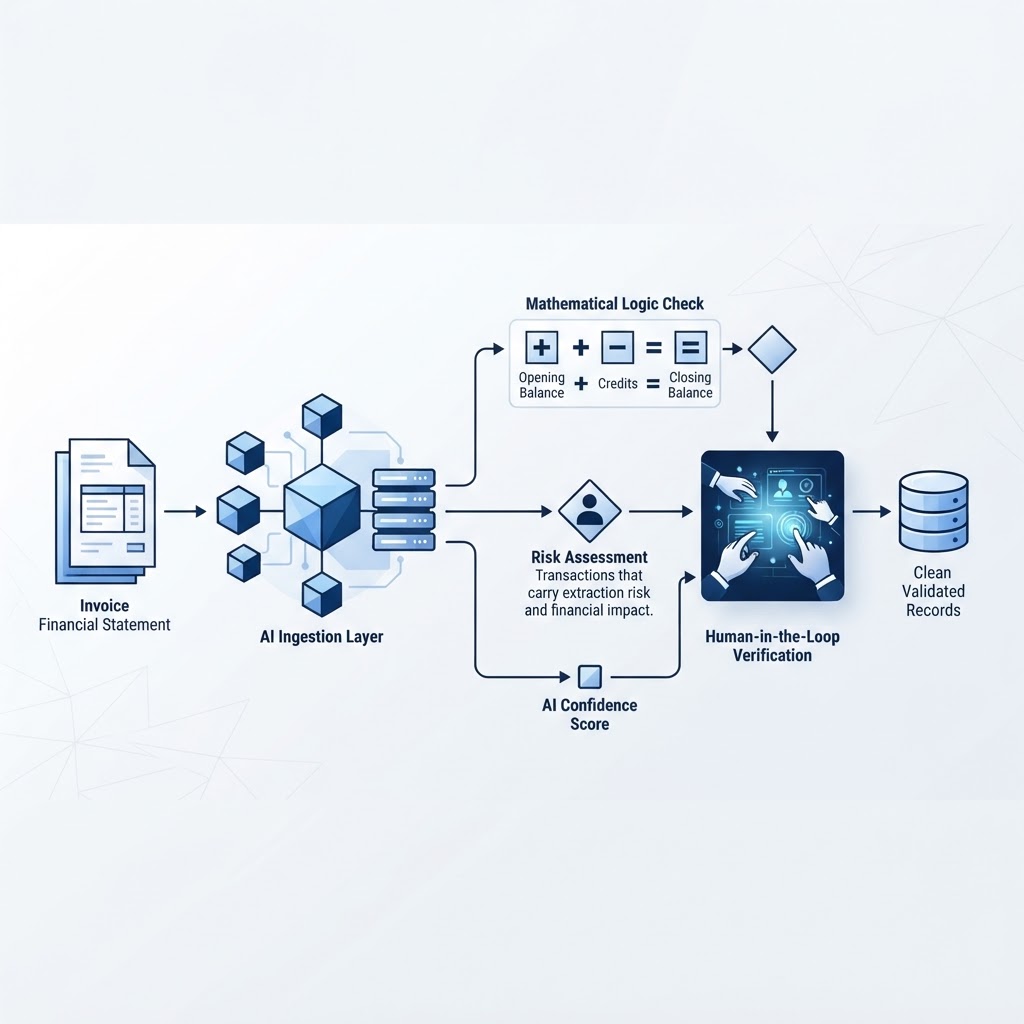
Accounting teams verify AI document extraction by separating what the model claims about itself (a confidence score) from what can be independently checked: grounding each value against the source image and running structural checks like opening-balance-plus-credits-minus-debits-equals-closing-balance. The most reliable workflows then route only the transactions that carry both extraction risk and financial impact into mandatory human review, rather than reviewing everything the model happens to flag as uncertain.
It's the last week of the month, and a bookkeeping team has forty bank statements to clear before close. AI extraction software has already pulled the dates, descriptions, and amounts from each PDF. The real question isn't whether to use the software — most teams already do. The question is whether a confidence score on screen is enough reason to click "approve," or whether there's a more reliable way to know the number is actually right before it lands in a client's ledger.
That question matters because the cost of an error compounds. A misread transaction that clears review doesn't just sit wrong in a spreadsheet — it can throw off a reconciliation, misstate a loan applicant's cash flow, or require a messy correcting entry weeks later. Automating extraction is only half the job. The other half is building a verification layer that doesn't depend on the model's own opinion of itself.
The Limitations of Confidence Scores in Financial Ingestion
A confidence score is the model's internal estimate of how likely its own output is correct — it is not an external audit of accuracy, as Microsoft's documentation on interpreting model confidence scores explains. That distinction is easy to miss and important to hold onto.
In practice, this means two failure modes can occur in opposite directions:
- False high confidence. A transposed digit, a misread decimal, or a smudged character can still produce a number that fits the model's learned patterns well enough to score as highly confident — even though it's wrong.
- False low confidence. An unusual but perfectly correct value — an uncommon font, a faded thermal-printed statement, a currency symbol in an odd position — can trigger a low confidence score even though the extraction was accurate.
If a review workflow only checks items below a confidence threshold, it will miss the first category entirely and waste reviewer time on the second. Confidence scores are a useful signal, but on their own they are not a verification system.
Grounding: The Primary Mechanism for Visual Verification
Grounding means tying each extracted value back to its exact location on the source document, so a reviewer can compare the extracted text directly against the original image or PDF rather than trusting a summary of it.
This pattern already exists in mainstream accounting workflows. QuickBooks Online, for example, allows manual upload of bank statements as PDF or image files and provides a side-by-side view for verification before saving the data, according to a guide on importing bank statements into QuickBooks. That side-by-side comparison is grounding in its simplest form: the source and the extracted value sit next to each other so a human can judge them directly, instead of relying on a score.
Grounding matters more than confidence scoring for one practical reason: it doesn't ask the reviewer to trust the model's self-assessment. It gives them the same evidence the model used, so they can make an independent judgment. This is why transaction editing and correction tools that let a reviewer see and adjust extracted data before export are a meaningful part of a verification workflow, not just a convenience feature.
Structural Validation: The Arithmetic Layer of Error Detection
Structural validation checks whether extracted values obey known arithmetic relationships, independent of how confident the model felt about any single line.
The clearest example in bank statement processing is balance variance detection: opening balance, plus total credits, minus total debits, should equal the closing balance printed on the statement. This check doesn't care about font quality or confidence scores — it either balances or it doesn't.
Illustrative example: Suppose a statement shows an opening balance of $10,452.18. The extraction totals 42 transactions: $18,204.55 in credits and $15,009.32 in debits. The expected closing balance is:
10,452.18 + 18,204.55 − 15,009.32 = 13,647.41
If the statement's printed closing balance is also $13,647.41, the extraction passes structural validation — regardless of whether every individual line scored high or low confidence. If the printed closing balance is instead $13,635.41, a $12.00 variance exists somewhere in the 42 transactions, even if every single line reported high confidence. That variance is the signal worth chasing, not the confidence score.
Structural validation extends past arithmetic into export compatibility. CSV files for QuickBooks Online must follow specific three-column or four-column formats to import successfully, per Intuit's own formatting guidance, and Xero requires CSV, OFX, or QIF files for statement imports — it does not natively accept PDF files, as documented by Docuclipper. A structurally valid extraction that fails to meet the destination's file format will still get rejected on import, so checking format compliance before export is part of the same validation layer.
Statement Flow's validation step applies this logic directly: it checks opening and closing balances, credit and debit totals, balance variance, and flags low-confidence transactions as a distinct signal from the arithmetic checks — giving a reviewer two separate, independent reasons to look closer, rather than one blended score.
A Risk-Based Decision Matrix for Human-in-the-Loop Review
Confidence scores and balance checks each tell you something different. The practical problem is deciding how much human attention a given transaction deserves. Treating every flagged line the same — whether it's a $4 coffee charge or a $40,000 wire transfer — wastes reviewer time on the former and under-protects against the latter.
A risk-based matrix solves this by mapping two independent axes:
Axis 1: Extraction/Structural Risk
- Low risk — high confidence score and the statement's balance check passes cleanly.
- Medium risk — either a low confidence score or a small balance variance, but not both.
- High risk — low confidence score combined with a balance variance, or a balance check that fails outright.
Axis 2: Financial Impact
- Low impact — small routine transactions, internal expense coding, low materiality to the account as a whole.
- Medium impact — transactions that affect reconciliation totals but fall under a materiality threshold the firm sets for itself.
- High impact — transactions feeding a lending decision, a forensic review, or any dollar amount large enough to move a client's reported position materially.
Combining the axes produces a practical review policy:
- Low risk + Low impact: No mandatory review. Periodic spot-checks are enough.
- Low risk + High impact: Accept automatically, but log it clearly for the audit trail given the stakes involved.
- Medium risk + Medium impact: Line-by-line review against the grounded source image before export.
- High risk + Low impact: Quick individual review — dollar exposure is small, but the discrepancy still needs a human eye.
- High risk + High impact: Full stop. The transaction, and arguably the statement, is held from export until a reviewer resolves the discrepancy and documents how it was resolved.
Worked illustrative example: Picture a 200-transaction statement where the model flags three lines as low confidence. One is a $9,400 wire transfer feeding a loan underwriting file; the other two are $15 recurring subscription charges. Confidence score alone would treat all three identically. The risk-based matrix doesn't: the wire transfer lands in the high-risk, high-impact cell and gets a full stop and manual resolution, while the two subscription charges land in a lower-impact cell suitable for quick batch review. The dollar exposure, not the model's self-reported uncertainty, drives the review effort.
This matrix is a decision-making framework, not a measured outcome — firms should calibrate their own impact thresholds based on client materiality and risk tolerance, since no universal threshold applies to every practice.
Audit-Ready Workflows: Traceability and Feedback Loops
A review step only strengthens an audit trail if it's recorded somewhere. Document history and the ability to re-download the original CSV or JSON output mean every correction a reviewer makes has a record attached — what the model originally extracted, what a human changed, and when.
That record also feeds forward. Human-in-the-loop workflows use review checkpoints to correct errors and inform future model performance, as described in Microsoft's documentation on document intelligence feedback mechanisms. For fintech teams building their own review queues on top of extracted data, a REST API with webhooks allows that correction step to be wired directly into an internal tool rather than handled purely through a manual export-review-import cycle.
How Do Accounting Teams Verify AI Document Extraction Before Exporting to Ledgers?
They combine three independent checks rather than relying on any single score: grounding the extracted value against the source document image, running structural checks like balance variance detection, and applying a risk-based decision about how much review a given transaction needs based on its financial impact — not just its confidence score. Each check catches something the others miss. Grounding catches visual misreads a human can spot instantly but a score can't describe. Structural validation catches arithmetic inconsistencies that a confident-sounding model can still produce. The decision matrix makes sure reviewer time goes where the dollar exposure actually is.
What Checks Prevent OCR Errors When Parsing Financial Statements?
The core checks are opening and closing balance verification, credit and debit total cross-checks, balance variance detection, and low-confidence transaction flagging — used together, not in isolation. None of these checks guarantees a statement is error-free; a balance can match by coincidence even if two individual transactions are both wrong in offsetting directions. That's a known limitation worth stating plainly: structural validation catches inconsistency, not every possible error. It's one more reason the decision matrix treats high-impact transactions as worth a human look even when the math appears to balance.
A Practical Verification Checklist
- Confirm the extraction tool grounds each value to its source location so a reviewer can compare it directly to the original PDF or image.
- Run the balance variance check: opening balance plus credits minus debits should equal the closing balance printed on the statement.
- Separate the confidence-score flags from the structural-check flags — treat them as two distinct signals, not one blended score.
- Assign a financial-impact level to each flagged transaction based on dollar size and downstream use (routine bookkeeping versus lending or forensic review).
- Apply the risk-based matrix to decide whether a flagged item needs a quick glance, a line-by-line review, or a full stop before export.
- Confirm the output file format matches the destination's requirements — a three or four-column CSV for QuickBooks, or CSV/OFX/QIF rather than PDF for Xero — before attempting import.
- Keep a record of every correction made during review, including the original extracted value, so the correction is traceable later.
Statement Flow applies this layered approach directly: it extracts transaction data from bank-statement PDFs and images, runs opening/closing balance checks and credit/debit totals, flags low-confidence transactions separately from structural variance, and lets a reviewer edit transactions before exporting to CSV, JSON, QuickBooks, Xero, Google Sheets, or Excel. It does not replace a full ledger system, and it does not provide accounting, tax, or legal advice — the review and judgment stay with the accountant. For teams deciding where AI extraction fits into an existing close process, seeing how the conversion and validation steps work in practice is a reasonable next step before changing a workflow.
Frequently Asked Questions
Should every transaction with a low confidence score get a full human review?
Not necessarily. A low confidence score only tells you the model was uncertain about one line — it doesn't tell you whether that line matters financially. The risk-based matrix pairs confidence and structural signals with financial impact, so a $15 subscription charge and a $9,400 wire transfer that are both flagged as low confidence don't get the same level of review.
Can structural validation catch every type of extraction error?
No. Balance variance detection catches inconsistencies in the arithmetic, but it's possible for two separate errors to offset each other and still leave the statement balancing on paper. That's one reason high-impact transactions deserve a human look even when the structural check passes cleanly.
Does Statement Flow replace a bookkeeper's ledger or file taxes automatically?
No. Statement Flow converts bank-statement PDFs and images into structured CSV or JSON data and can export that data into supported accounting workflows, but it is not a full accounting or bookkeeping ledger system, does not file taxes, and does not provide accounting, tax, or legal advice.
Sources
- Interpret and improve model accuracy and confidence scores - Foundry Tools — Microsoft
- How to Import Bank Statements into QuickBooks (Every Method) — Invoicedataextraction.com
- Import Bank Statement Transactions into Xero — Docuclipper
- Format CSV files in Excel to get bank transactions into QuickBooks — Intuit
- Azure document Intelligence feedback mechanism with Human in the loop — Microsoft
Related on StatementFlow
This article was produced by StatementFlow's AI-assisted editorial workflow and reviewed against sourced evidence and verified product documentation before publication.